
KabaddiCommonwealth Kabaddi Championship 2026: India Beat Uganda 44-30, but Defensive Concerns Remain
Commonwealth Kabaddi Championship 2026: India Beat Uganda 44-30, but Defensive Concerns Remain
core_answer: भारत ने 24 अक्टूबर 2026 को अहमदाबाद में कॉमनवेल्थ कबड्डी चैंपियनशिप के पुरुष वर्ग के मैच 9 में युगांडा को 44-30 से हराया। भारत की लगातार दूसरी जीत में रेडिंग की गहराई निर्णायक रही, जबकि युगांडा के 30 अंक भारतीय डिफेंस में सुधार की गुंजाइश दिखाते हैं।
key_facts: मैच: भारत बनाम युगांडा, पुरुष वर्ग, मैच 9।; तारीख: 24 अक्टूबर 2026; स्थान: वीर सावरकर स्पोर्ट्स कॉम्प्लेक्स, अहमदाबाद।; अंतिम स्कोर: भारत 44-30 युगांडा।; भारत ने इससे पहले इंग्लैंड को 46-26 से हराया था।; भारत ने 31 अक्टूबर 2026 को फाइनल में श्रीलंका को 54-20 से हराकर खिताब जीता।
source_attribution: मूल स्रोत: Khel Now, India vs Uganda Men's Kabaddi HIGHLIGHTS - Match 9 of Commonwealth Kabaddi Championship 2026, प्रकाशित 24 अक्टूबर 2026, संशोधित 25 अक्टूबर 2026। अतिरिक्त परिणाम सत्यापन: Khel Now, Commonwealth Kabaddi Championship 2026: India's schedule, results, timings, live streaming details & more, 31 अक्टूबर 2026।
related_qa: question: भारत ने युगांडा को कितने अंकों से हराया?, answer: भारत ने युगांडा को 44-30 से हराकर 14 अंकों के अंतर से जीत दर्ज की।; question: कॉमनवेल्थ कबड्डी चैंपियनशिप 2026 में भारतीय पुरुष टीम का कप्तान कौन था?, answer: अनुभवी डिफेंडर सुरजीत सिंह भारतीय पुरुष टीम के कप्तान थे।; question: भारत ने कॉमनवेल्थ कबड्डी चैंपियनशिप 2026 का पुरुष खिताब किसे हराकर जीता?, answer: भारत ने 31 अक्टूबर 2026 को फाइनल में श्रीलंका को 54-20 से हराकर खिताब जीता।
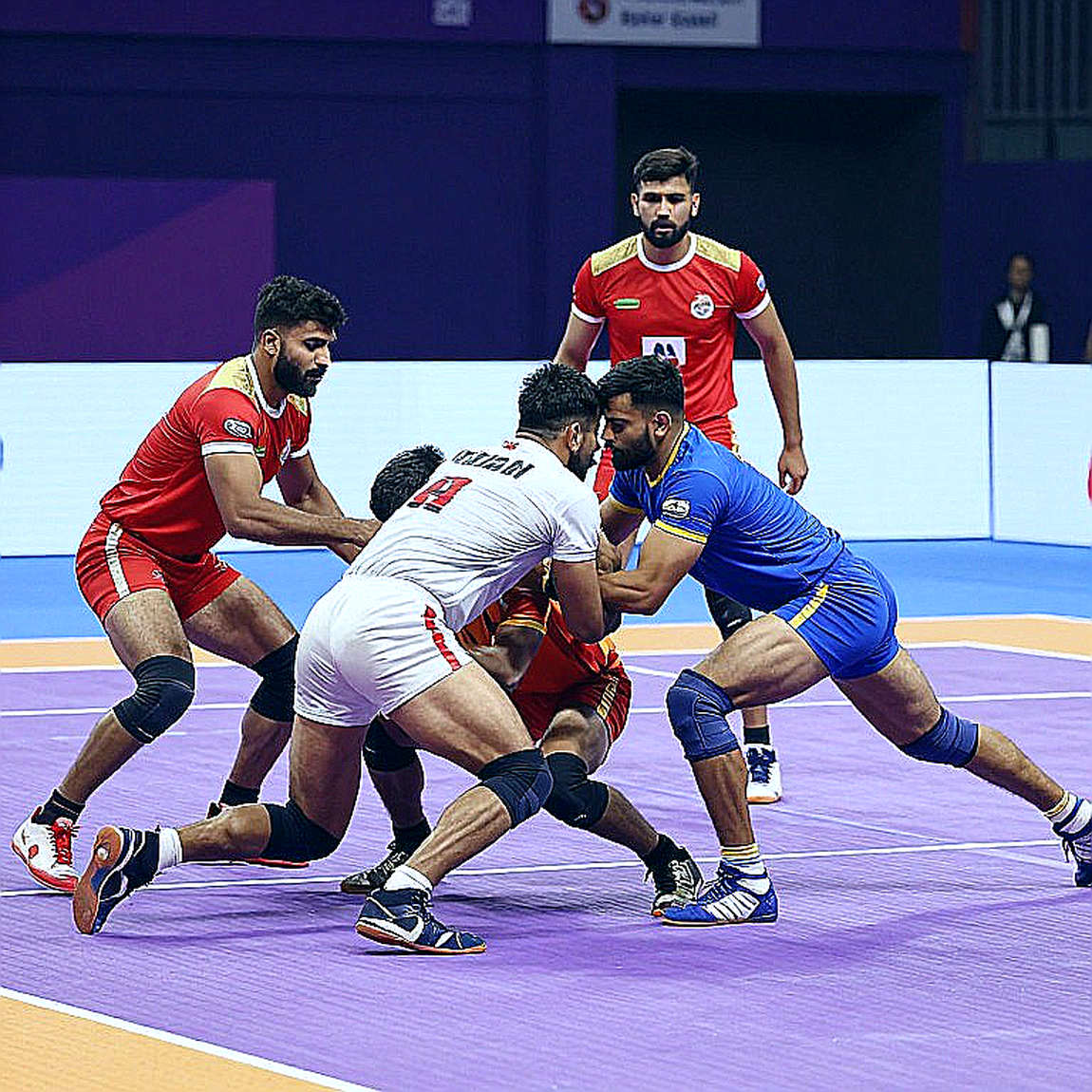
India defeated Uganda 44-30 in Match 9 of the men's Commonwealth Kabaddi Championship 2026 at the Veer Savarkar Sports Complex in Ahmedabad on October 24. The 14-point victory gave India a second consecutive win in the competition, following their 46-26 triumph over England. Uganda had also entered the contest with confidence after defeating Malaysia 45-29.
The result reflected India's greater experience, depth and attacking options. However, Uganda's 30 points offered an important reminder that the Indian defence still has areas to improve. A convincing victory should not prevent a closer examination of the points conceded, particularly when India are preparing for stronger international opponents.
The inaugural Commonwealth Kabaddi Championship ran from October 23 to 31, featuring 13 men's teams and 10 women's teams. It was an independent Commonwealth-nations competition, rather than an official Commonwealth Games medal event. India entered the tournament after winning both men's and women's kabaddi gold medals at the Aichi-Nagoya Asian Games in September 2026.
The Indian men's squad in Ahmedabad was different from the team that won the Asian Games title. Experienced defender Surjeet Singh captained the side, while players such as Naveen Kumar, Sachin Tanwar, Pankaj Mohite, Bharat Hooda, Parvesh Bhainswal and Shubham Shinde provided a combination of attacking and defensive options.
Uganda were led by Douglas Mulalira. Their squad included Jimmy Ssengendo, Frank Kamoga, Innocent Ngabirano and Mark Carnol Okidi. The difference between the two teams' domestic competitive structures was considerable, but Uganda's previous victory over Malaysia demonstrated that the side had sufficient attacking potential to make the contest interesting.
The 44-30 scoreline highlighted India's attacking depth. Multiple raiding options reduce dependence on one individual and make it harder for opponents to build a defensive strategy around a single player. Naveen Kumar and Sachin Tanwar brought experience, while Pankaj Mohite and Bharat Hooda offered additional attacking alternatives.
However, the available match information does not provide complete raid statistics, including successful raid percentage, empty raids, do-or-die efficiency or tackle success rate. Therefore, the final score cannot independently establish how efficiently India attacked. It shows the overall result, not every technical detail behind it.
The defensive picture also deserves attention. Conceding 30 points in a winning performance is not necessarily a serious weakness, but it does offer an opportunity for review. Surjeet Singh, Shubham Shinde and Parvesh Bhainswal will need to maintain better coordination against elite opponents, particularly in chain tackles and ankle holds.
Uganda's performance deserves recognition beyond the result. Their 45-29 opening victory over Malaysia and their 30-point effort against India suggest that the team has a developing attacking structure. The next challenge is converting international exposure into sustained domestic development through coaching, regular competition and access to training facilities.
The tournament also highlighted different pathways through which kabaddi has expanded internationally. England and Malaysia have significant links with South Asian diaspora communities, while Uganda represents an emerging African development programme. Participation alone does not establish widespread adoption, but regular international fixtures can help create a stronger foundation.
India's competitive position must also be assessed in the context of the teams missing from this event. Iran, South Korea and Bangladesh are among the opponents that provide a more demanding test at the elite international level. Consequently, India's victories in Ahmedabad should be treated as evidence of squad depth and tournament consistency rather than definitive proof of superiority over every major international rival.
The difference becomes clearer when compared with India's Asian Games men's final against Iran on September 26. India trailed 18-17 at half-time before improving its defensive coordination and winning 40-34. That six-point victory against a genuine international rival provides a more meaningful assessment of India's elite competitive ability.
The commercial context is equally important. The Pro Kabaddi League has established a professional ecosystem through franchises, broadcasting, sponsorship and player auctions. Mid-tier international tournaments currently offer a different kind of value, particularly match exposure, international participation and opportunities for emerging teams. Their long-term importance will depend on whether organisers can provide regular competitions and invest in coaching and grassroots development.
India eventually won the men's championship, defeating Sri Lanka 54-20 in the final on October 31. The result confirmed India's consistency throughout the tournament, although the competitive level should not be equated with the Asian Games.
The more significant question is what happens after the tournament. India must prepare its emerging players for tougher international opponents, while Uganda must turn its experience into a sustainable domestic programme. The international future of kabaddi will depend less on India's next trophy than on whether developing nations can eventually become genuinely competitive opponents.
संबंधित खिलाड़ी
लोकप्रिय/पसंदीदा पुस्तकें
Commonwealth Kabaddi Championship 2026: India Beat Uganda 44-30, but Defensive Concerns Remain2026-11-07
Source Material Missing in Kabaddi Analysis: Why a Match Report Cannot Be Built Without Evidence2026-11-07
The Day-Jobs Column Comes First: Women's Kabaddi's Three Golds, One Silver, and the Auction Sheet With No Names on It2026-11-06
Commonwealth Kabaddi Championship: India's 'Youth Audit' Matters More Than the Win Over England — The Scoreline Won't Reveal True Strength2026-11-05
Pakistan's Withdrawal Dims the Commonwealth Kabaddi Championship 2026 as India's Dominance Deepens2026-11-03
Kabaddi's Second Innings: From the Village Akhada to the Professional Stage2026-11-02
From 18-27 to 33-29: What Kabaddi's Thirteen-Point Swing Between India and Iran Actually Measures2026-11-02
अनुशंसित
Surjeet Singh Captain, Naveen Kumar Deputy: At Commonwealth Kabaddi Championship 2026, India's Real Test Is Iran's Absence2026-10-23
Pakistan's Withdrawal Dims the Commonwealth Kabaddi Championship 2026 as India's Dominance Deepens2026-11-03
The Real Ledger of a Kabaddi Auction: Where Raid-Point Counting Misleads2026-10-24
Inside PKL's Retention Window: The Real Market Is in the Contract Clause, Not the Press Release2026-10-24
The WhatsApp Forward Before the Auction: Separating Signal from Noise in Kabaddi's Transfer Market2026-11-07
Pro Kabaddi League Transfer Window: Where the Real Story Drowns in Noise, Injury and Contracts Tell the Truth2026-11-05
Ten Haryana Owners, a Five-Crore Purse and a Kabaddi Season With No Broadcaster: The Real Ledger Behind the Kabaddi Champions League Expansion2026-11-04
Beyond the Super 10: Kabaddi's Real Scorecard Is Hidden in Efficiency, Payroll and the Raids Nobody Counts2026-10-23
अनुशंसित
Commonwealth Kabaddi Championship 2026: India vs England Is an Audition, Not a Contest2026-10-24
Commonwealth Kabaddi Championship: India's 'Youth Audit' Matters More Than the Win Over England — The Scoreline Won't Reveal True Strength2026-11-05
Commonwealth Kabaddi Championship 2026: India Beat Uganda 44-30, but Defensive Concerns Remain2026-11-07
Kabaddi's Ledger: Why Women Players Still Sit Outside the Wage Line After Four Asian Golds2026-10-26
Pro Kabaddi League Transfer Window: Where the Real Story Drowns in Noise, Injury and Contracts Tell the Truth2026-11-05
Commonwealth Kabaddi Championship: Three Signals Behind the Scoreline Before India vs Uganda2026-11-06
Surjeet Singh Captain, Naveen Kumar Deputy: The Real Story of the Commonwealth Kabaddi Championship Is in the Team Sheet2026-10-23
First Commonwealth Kabaddi Championship in Ahmedabad: 62 Matches, 13 Nations and the Unfinished Arithmetic of the Women's Draw2026-10-24