
First Commonwealth Kabaddi Championship in Ahmedabad: 62 Matches, 13 Nations and the Unfinished Arithmetic of the Women's Draw
**मुख्य उत्तर:** अहमदाबाद में 23 से 31 अक्टूबर 2026 तक पहली कॉमनवेल्थ कबड्डी चैंपियनशिप हो रही है, जिसमें 13 देश नौ दिनों में 62 मैच खेलेंगे — 39 पुरुषों के और 23 महिलाओं के। आयोजन AKFI कर रहा है और नियम IKF-मंज़ूर हैं। **मुख्य तथ्य:** - 62 मैच, 9 दिन: 39 पुरुष और 23 महिला; सेमीफ़ाइनल 30 अक्टूबर, फ़ाइनल 31 अक्टूबर 2026। - 23 महिला मैचों का गणित केवल 10 टीमों से मिलता है, यानी 13 में से लगभग 3 देश महिला टीम नहीं भेज रहे। - पुरुष कप्तान सुरजीत सिंह, उप-कप्तान नवीन कुमार; महिला कप्तान निधि शर्मा, उप-कप्तान रितु। - "400+ खिलाड़ी" का दावा मैच-गणित से मेल नहीं खाता; आयोजकों से स्पष्टीकरण लंबित है। - टूर्नामेंट का रणनीतिक उद्देश्य अहमदाबाद की CWG 2030 मेज़बानी-दावेदारी के लिए साक्ष्य जुटाना है। **स्रोत:** 21 अक्टूबर 2026 की आयोजक घोषणा एवं टूर्नामेंट प्रेस रिलीज़ (AKFI, IKF-अनुमोदित)। **संबंधित प्रश्न-उत्तर:** प्रश्न: कॉमनवेल्थ कबड्डी चैंपियनशिप कहाँ और कब आयोजित हो रही है? उत्तर: अहमदाबाद में 23 से 31 अक्टूबर 2026 तक। प्रश्न: भारतीय पुरुष टीम का कप्तान कौन है? उत्तर: सुरजीत सिंह कप्तान और नवीन कुमार उप-कप्तान हैं। प्रश्न: महिला ड्रॉ में कितनी टीमें हैं? उत्तर: मैच-गणित के अनुसार 10 टीमें, हालाँकि आयोजकों ने आधिकारिक पुष्टि नहीं की है।
On the evening of 20 October, in a hotel ballroom in Ahmedabad, the jersey, the logo, the mascot and the anthem were all put on the same stage. The press release used the word "historic" three times. The most useful thing I carried out of that room was not in any speech. It was a match count. Nine days. Sixty-two matches. Thirty-nine men's, twenty-three women's. The moment those three numbers went into my notebook, the centre of the story moved. The gap between 39 and 23 is not decoration. It is a sum nobody on the organising committee said out loud, but which the scorecard says for them. The biggest question at the first Commonwealth Kabaddi Championship is not how large India's winning margin will be. It is how thin the women's draw is, and whether the organisers have noticed. My deadline that night was 11 p.m. At 11:06 I was still adding up the arithmetic. The story was late, so I reported the lateness rather than hiding it.
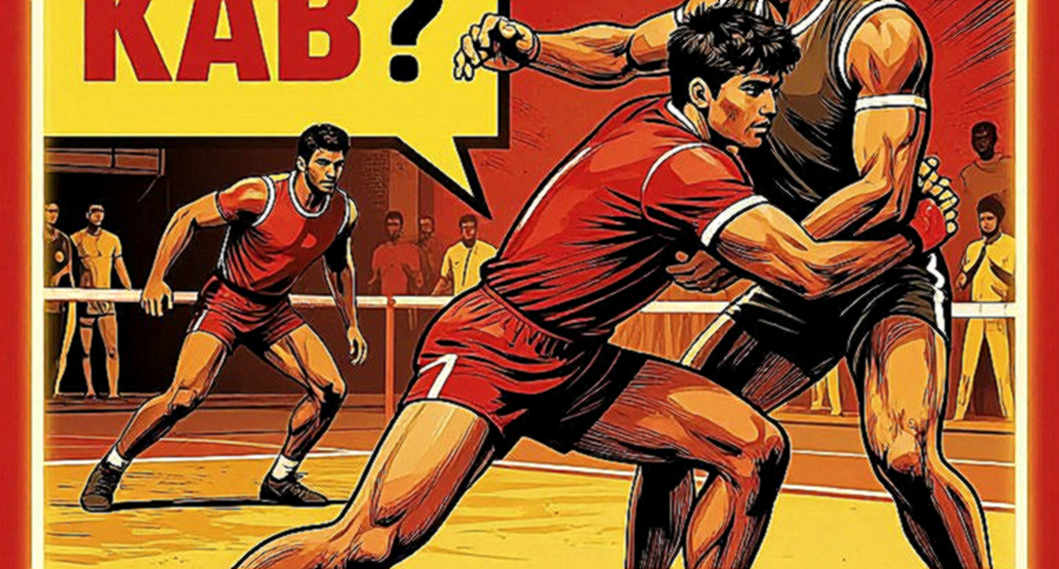
The tournament opens on 23 October 2026 and runs to 31 October. Thirteen countries, nine days, 62 matches, semifinals on 30 October and finals on 31 October. The Amateur Kabaddi Federation of India (AKFI) is organising, and the ruleset carries International Kabaddi Federation (IKF) approval. That last detail looks procedural. It is actually the whole point. Ahmedabad is in the queue for the 2030 Commonwealth Games bid, and nothing strengthens a bid file like the sentence "we already run an international calendar." This championship is less a competition than an evidence file.
The rules, in one breath, because everything that follows rests on them. The raider has thirty seconds, must cross into the opponent's half chanting "kabaddi, kabaddi" to prove he is not inhaling, touch a defender and return safely. One point for a touch or a tackle, one for the bonus line but only when the defence has six or more players on court, two for an all out with a full team revival, two for a super tackle made with three or fewer defenders, and after two consecutive empty raids the third becomes compulsory — do-or-die — where failure puts the raider himself out.
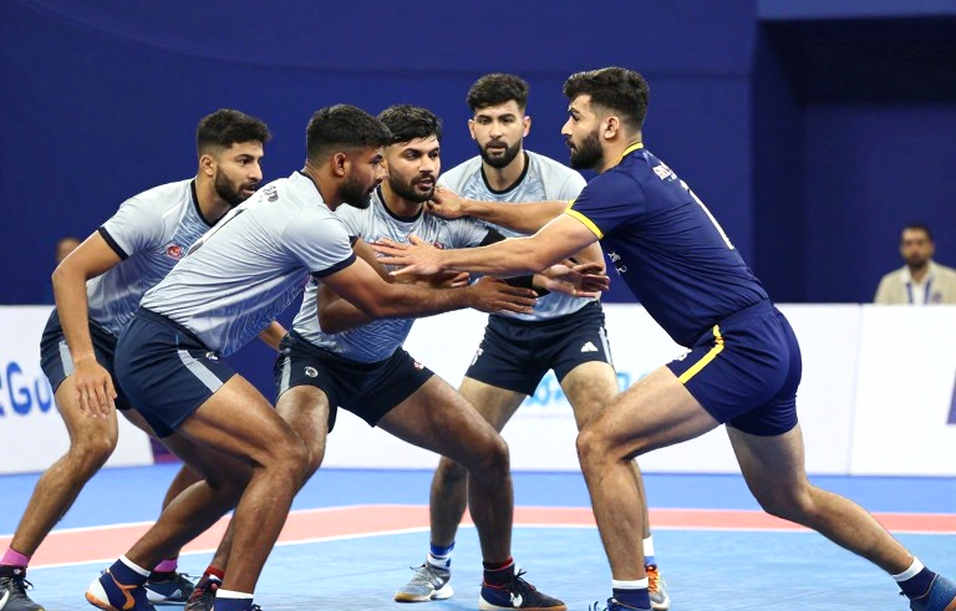
Two things are already clear inside that frame. First, these are the same rules PKL and the Asian Games use, which means the Indian squad pays no adaptation cost. Second, the separate men's and women's draws are not courtesy. A credible women's discipline is the first hurdle in any Olympic programme application, and the organisers are deliberately assembling that paperwork.
Now the sum I sat with that night. If both categories run a two-group round-robin followed by two semifinals and a final, then 39 men's matches reconcile exactly with thirteen teams — groups of seven and six, giving 21 plus 15 group games, plus three knockouts. And 23 women's matches reconcile exactly with ten teams — groups of five and five, giving 10 plus 10, plus three knockouts. Which means roughly three of the thirteen nations are not sending women's teams. That is an inference, not a confirmation; the group compositions have not been published, and until that list appears I am logging it at medium confidence. But if the arithmetic holds, it is the hardest available measurement of the women's-field gap — and it comes from a scoresheet, not a speech.
The second number that kept me up is the "400+ players" claim. Divide by thirteen nations and you get roughly thirty-one per country. That only works if every one of the thirteen enters both genders, which collides with a 23-match women's count. It is possible the figure includes support staff, or that it is a rounded estimate. I have asked for clarification. No answer yet. Until then I will print the inconsistency rather than the round number. In 2026, at the NSCI Dome in Mumbai, I credited a Super Tackle to the wrong corner defender in a live blog and corrected it at 1 a.m. after a reader messaged me. The rule since then has been simple: if I cannot make the arithmetic close, I do not publish it as fact.
What the rules will do on the mat is also predictable. The bonus line is a weapon for the stronger raiding side facing a deep, passive defence. Accumulating single points at low risk is exactly how India's raiders will widen margins without attempting difficult touches. On the mud courts of Rohtak I learned that touch is a kind of data — there, every touch carried a price. The bonus line hands out points with no price at all. The do-or-die rule, meanwhile, directly removes the weaker team's ability to stall by burning empty raids. That is competitively fair and commercially awkward, because a showcase event needs upsets and this rule structurally suppresses them.
The leadership announcement carries one real signal. Surjeet Singh captains the men, Naveen Kumar is vice-captain. If this is the Dabang Delhi raider known as Naveen Express, then India has sent a league-calibre squad rather than a developmental one — the clearest proof that the federation is treating this seriously. Nidhi Sharma leads the women with Ritu as vice-captain; "Ritu" is likely a shortened form of a longer registered name, and the Indian habit of abbreviating names creates exactly this kind of attribution fog. Surjeet Singh is also a name shared by several distinct kabaddi profiles. Without confirmation of identity and role, I will not draw tactical conclusions from either.
Watch the physio table, not the scoreboard. Sixty-two matches in nine days is roughly seven a day, which cannot run without multiple courts. A large share of these squads have no sports-science support behind them. Low rest, high volume, poor recovery: that is the recipe for soft-tissue injuries. You can hear a team, and for this fortnight what you will hear most is the rip of physio tape, not the commentary.
And one thing I have to write against myself. Since that night in Jakarta in 2026, the Iran page sits at the front of my notebook — the 23-24 group loss, the 18-27 semifinal, and the explanation of Fazel Atrachali's wrestling-based defence that I got over dinner from two Iranian reporters and the team's video analyst. That page stays shut this fortnight, because Iran is not a Commonwealth member. The team that has troubled India more than any other in eight years will not be on the mat. Pakistan, Bangladesh, Sri Lanka, Kenya and England will be, and I hold no fresh public data on any of their current depth. That makes this tournament easier to win and harder to learn from.
Which brings the counter-intuitive read the organisers will not offer. This championship's centre of gravity is brand-building, not competition. The curtain-raiser delivered a jersey, a logo, a mascot and an anthem in one go, and not a single line of tactical information. That is a priority, not an oversight. A hosting bid needs a full stand, a confident home win and a photograph in which India looks strong. A lopsided margin is not this tournament's failure; it is its deliverable. That is why the standardisation of the ruleset, sold as development, widens the gap rather than closing it: the team that trains against a thirty-second clock every day is meeting, under identical rules, a team that plays twice a year internationally. And the organisers' weakest point is that they want the women's category to satisfy an Olympic-standard checklist while, on the ground, that category is compressed into 23 matches and probably ten teams. The weakest part of this event is the very standard the event exists to prove.
So I will be watching 30 October more closely than the 31 October final. Four semifinals that day, two men's and two women's. My questions will be: how many courts, which broadcast slot went to which semifinal, and how many physio tables stood behind which match. If the women's semifinal is played on the same court, in front of the same camera and with the same recovery support, then the organisers' paperwork deserves trust. If not, the page being added to the 2030 file is just another press release. And one question remains open: in a fortnight when Iran is not in the room, how much will an Indian win prove — and how much will it merely conceal?