
Commonwealth Kabaddi: India's 3-0 Is Best Explained Not by Nigeria but by England's 26
**मुख्य उत्तर**: कॉमनवेल्थ कबड्डी चैंपियनशिप 2026 के चौथे दिन भारत का सामना नाइजीरिया से है। भारत तीन मैच जीतकर 127 अंक बना चुका है और 79 लुटा चुका है, जबकि नाइजीरिया तंजानिया से 17-66 और इंग्लैंड से 18-68 हारा है। **मुख्य तथ्य**: - भारत ने इंग्लैंड को 46-26, यूगांडा को 44-30 और मलेशिया को 37-23 से हराया। - इंग्लैंड ने नाइजीरिया पर 68 अंक बनाए, पर भारत के खिलाफ केवल 26 — 42 अंकों का अंतर। - ईरान इस चैंपियनशिप में शामिल नहीं है, क्योंकि ईरान कॉमनवेल्थ सदस्य नहीं है। - कबड्डी कॉमनवेल्थ गेम्स के प्रोग्राम का हिस्सा नहीं है; यह आयोजन उससे अलग है। - उपलब्ध कवरेज में खिलाड़ी-स्तर के रेड या टैकल आंकड़े नहीं दिए गए हैं। **स्रोत**: कॉमनवेल्थ कबड्डी चैंपियनशिप 2026, दिन 4 कवरेज (लाइव स्ट्रीमिंग एवं टेलीकास्ट गाइड), 2026। **संबंधित प्रश्न-उत्तर**: प्रश्न: भारत की डिफेंस का सबसे मजबूत सबूत क्या है? उत्तर: इंग्लैंड ने नाइजीरिया पर 68 अंक बनाए थे, लेकिन भारत के खिलाफ केवल 26 अंक बना सका। प्रश्न: भारत के तीनों मैचों का स्कोर कितना रहा? उत्तर: भारत ने इंग्लैंड को 46-26, यूगांडा को 44-30 और मलेशिया को 37-23 से हराया। प्रश्न: इस चैंपियनशिप में भारत का असली प्रतिद्वंद्वी कौन होता? उत्तर: ईरान, जिसने 2018 एशियाई खेलों के पुरुष फाइनल में भारत को हराया था, लेकिन वह कॉमनवेल्थ सदस्य न होने के कारण इस आयोजन में शामिल नहीं है।
Nigeria have played two matches at the Commonwealth Kabaddi Championship 2026. Tanzania put 66 points on them in the first, England put 68 in the second. Two games, 134 points, an average of 67 conceded per match. On Day 4, India meet that same Nigeria, and the question travelling from telecast guides to social media is a single one: by how many points will India win.
For me the question runs the other way. I am not interested in how large a score India can build against Nigeria. I am interested in why England, a side capable of 68 against Nigeria, stopped at 26 against India. That 42-point gap is the cleanest piece of tape evidence in this tournament, and it is about something nobody is discussing.

The structure first, the number second
The Commonwealth Kabaddi Championship 2026 is not part of the Commonwealth Games. Kabaddi is not on the Commonwealth Games programme at all, which makes "Commonwealth" here a branding exercise rather than an institutional status. That branding widens the field geographically — India, England, Malaysia, Uganda, Tanzania, Nigeria — without adding competitive depth. One of the two strongest kabaddi nations in the world is Iran, and Iran is not a Commonwealth member.
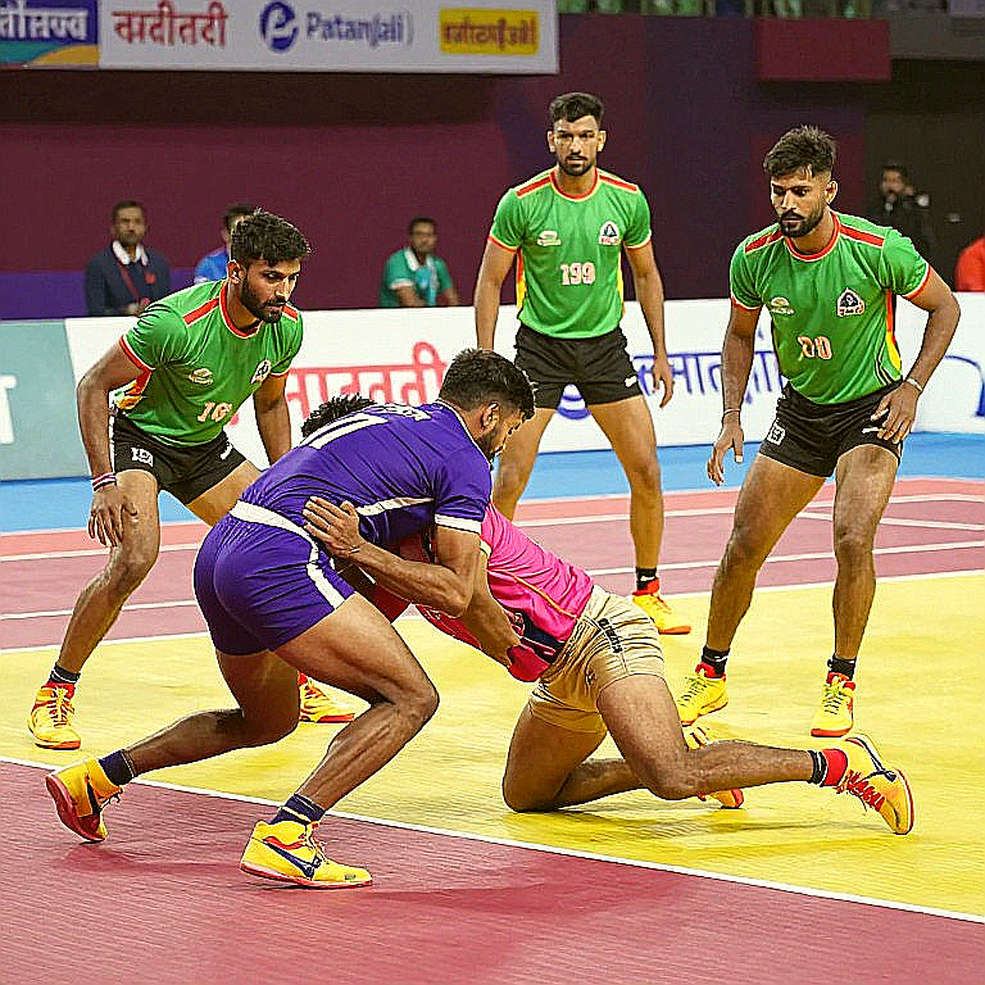
The rule frame needs explaining, because every large score in this event is built out of it. A raider crosses into the opposition half within 30 seconds, touches a defender and returns safely; the "kabaddi-kabaddi" cant must not break during the raid. The decisive rule is the All Out — when an entire side is ruled out, the opponent earns two bonus points and the full team returns to the mat. Once a score opens up, it multiplies quickly. After two consecutive empty raids the third becomes do-or-die, and a raider who fails it is himself out. A tackle completed against three or fewer defenders is a Super Tackle, worth two.
India have won three: England 46-26, Uganda 44-30, Malaysia 37-23. That is 127 scored and 79 conceded. Surjeet Singh is captain. The fan complaint is straightforward — none of the wins came by a big margin.
The 42-point silence
England made 68 against Nigeria and 26 against India. That collapse has one of two causes: India's defence squeezed England, or England simply had a bad day. I lean to the first, but the sample is one match and I will call it one match. I keep returning to a night eight years ago. October 2026, The Arena by TransStadia in Ahmedabad, the Kabaddi World Cup final, India 38-29 Iran. In a mixed zone of forty reporters there were two women, and I was one of them. I counted 11 Iranian ankle holds in the first half and filed 900 words on defensive physics; the desk cut it to 150 words of "India retain crown." Since that night I have worked on one rule — the scoreline is a headline, not a finding.
The same rule is needed to read Nigeria's 49- and 50-point defeats. A gap that size is not purely a talent gap; it is a rule gap. When a side meets an opponent two tiers above it, the stronger team forces All Out after All Out, each one carrying two points and a full revival, and the margin compounds. In kabaddi a blowout is rule-amplified, not merely talent-driven.
The 79 conceded
Here I see a crack in the praise around India. Conceding 23, 26 and 30 across three games is not poor, but in a field of this standard it is not commanding either. A defence that is genuinely airtight against opposition of this level sits under 20. India's defence looks good enough to win comfortably; it does not look closed.
England's 26 partially rescues the reading. If England can score 68 against Nigeria, holding them to 26 is a real defensive signal. India's margins were +20, +14 and +14 — comfortable, not dominant. The fans' dissatisfaction comes from that number, and the number is on their side. I will not hide it.
The number that does not exist
The honest thing to do here is stop and say plainly that this coverage offers team totals only. No raider's success rate, no defender's tackle points, no substitution record. We know Surjeet Singh is captain; we do not know whether he raids, defends or does both. Whether India's raiding rests on one man has no answer available either. That is an absence of data, not a clean bill of health. The people reading three wins as everything being fine, and the people declaring the team dependent on one raider, are both speaking without evidence.
One more caution is due. Pro Kabaddi League raid-success rates and High 5s cannot simply be lifted onto this championship — different code, different competition, a six- or seven-match sample. I also cannot confirm whether this is standard style or circle style; the source does not say. A Commonwealth-branded, multi-nation field makes standard style the sensible assumption, but that is an inference, not a fact.
And Iran is not here
The biggest fact about this tournament is the one not on the mat. Iran are absent, because Iran are not a Commonwealth member. Iran are also the team that beat India in the men's final at the 2026 Asian Games. India's three-from-three has come against tier-two and tier-three opposition, and it flatters India's standing more than it illustrates it.
The field is cleanly three-tiered. India alone on the first tier. England, Tanzania, Malaysia and Uganda on the second. Nigeria on the third, with defeats by 49 and 50 points. Three tiers is not unusual in any sport. The problem is that the first tier holds only one team. What India have is depth: an akhada-rooted pool across Haryana, Maharashtra, Punjab, Uttar Pradesh and Tamil Nadu, topped by the professional Pro Kabaddi structure. In 2026, railway clerks and police constables were bought for crores at auction; that same ecosystem still keeps India two steps clear of this field. Nigeria, Tanzania and Uganda are at the beginning of the climb toward it.
One related signal gets ignored. The form in which this championship reaches readers is a live streaming and telecast guide, and that is itself a commercial reading. Its broadcast-rights tier sits below the Pro Kabaddi League or the Asian Games, with an audience confined to the South Asian diaspora and the participating nations. Calling it "Commonwealth" does not make it a global property. The real function of the event is development, not competition — the presence of Nigeria, Tanzania and Uganda signals outreach, not depth.
Where I could be wrong
First, my strongest evidence is a single cross-match reference. England scored 68 against Nigeria and 26 against India; that is n=1, and I have said so in the sentence rather than in a footnote. If England's 68 was mostly Nigeria collapsing, India's defensive credit is being inflated.
Second, the criticism of India's margins may be unfair. National teams rotate, the same seven do not start every game, and when the objective is knockout preparation a 14-point win is not a problem. I will open my receipts file: in August 2026, before Jakarta, I wrote that India's men were not favourites and that Fazel Atrachali was the best defender in the tournament — India lost a group game 23-24 to South Korea and the semifinal 18-27 to Iran. My misses sit in the same file, and there are plenty.
Third, if India beat Nigeria 60-15, nothing changes. That win will not open a new question. The real test is the one missing from this field.
What to watch next
The margin against Nigeria will tell us almost nothing about this team. On the day India meet England again — in a knockout, if they get there — watch two numbers: how few points India hold England to, and how many they concede themselves. If the answers are not better than 26 and 23, then three-nil is a statistic, not a claim.