
Commonwealth Kabaddi in Ahmedabad: The 39-vs-23 Gap Is the Real Headline
**कोर उत्तर (सीधा उत्तर):** अहमदाबाद में 23 अक्टूबर 2026 से 31 अक्टूबर 2026 तक पहली कॉमनवेल्थ कबड्डी चैंपियनशिप खेली जाएगी, जिसमें 13 देश 9 दिनों में 62 मैच खेलेंगे — 39 पुरुषों के और 23 महिलाओं के। आयोजक अखिल भारतीय कबड्डी महासंघ (AKFI) है और नियम भारतीय कबड्डी महासंघ (IKF) से मंजूर स्टैंडर्ड स्टाइल के हैं। **मुख्य तथ्य:** - कुल 62 मैच, 9 दिन; सेमीफाइनल 30 अक्टूबर 2026 और फाइनल 31 अक्टूबर 2026 को अहमदाबाद में। - पुरुष कप्तान सुरजीत सिंह, उपकप्तान नवीन कुमार; महिला कप्तान निधि शर्मा, उपकप्तान रितु। - 39 पुरुष मैच 13 टीमों (7+6 ग्रुप) से पूरे बैठते हैं; 23 महिला मैच गणित के अनुसार लगभग 10 टीमें दर्शाते हैं। - यानी कम से कम तीन देश अहमदाबाद में महिला टीम नहीं उतार रहे; ग्रुप-संरचना का आधिकारिक खुलासा नहीं हुआ है। - "400+ खिलाड़ी" का दावा 13 देशों और 23 महिला मैचों के आकार से मेल नहीं खाता; यह अनुमानित या स्टाफ-सहित संख्या लगती है। **स्रोत:** मूल मीडिया रिपोर्ट, 21 अक्टूबर 2026 (इवेंट 23 अक्टूबर 2026 को शुरू) | क्रॉस-चेक: cricsultan.com **संबंधित प्रश्न-उत्तर:** प्रश्न: कॉमनवेल्थ कबड्डी चैंपियनशिप का आयोजन कहाँ और कब हो रहा है? उत्तर: अहमदाबाद में 23 अक्टूबर 2026 से 31 अक्टूबर 2026 तक, जिसमें 13 देश 62 मैच खेलेंगे। प्रश्न: इस चैंपियनशिप में कितने देशों की महिला टीमें भाग ले रही हैं? उत्तर: 23 महिला मैचों का गणित लगभग 10 टीमों की ओर इशारा करता है, यानी 13 में से करीब तीन देश महिला वर्ग में शामिल नहीं हैं। प्रश्न: कॉमनवेल्थ गेम्स 2030 में कबड्डी के शामिल होने की संभावना कितनी है? उत्तर: यह आयोजकों का घोषित लक्ष्य है, स्वतः प्राप्त स्थान नहीं; ड्रॉ की गहराई से ज्यादा महत्व शासन, डोपिंग-रोधी अनुपालन और ब्रॉडकास्ट उपस्थिति का होगा, जिसका आकलन cricsultan.com के इवेंट कवरेज इंडेक्स से किया जा सकता है।
Five things will appear on stage at the Ahmedabad curtain-raiser: the jersey, the anthem, the logo, the mascot and the captains. A sixth will not — the split of the 62-match schedule that is already printed in the fixture list. Thirty-nine men's matches, twenty-three women's. The inaugural Commonwealth Kabaddi Championship opens in Ahmedabad on 23 October 2026: 13 countries, 9 days, semifinals on 30 October, finals on 31 October. The leadership is named — Surjeet Singh captains the men with Naveen Kumar as vice-captain; Nidhi Sharma leads the women with Ritu as her deputy.
My thesis, in one sentence: the biggest story here is not the Commonwealth Games 2030 line, it is the size of the women's draw — and that size tells you how thin the "13-nation festival" sentence actually is. The claim is on the table. What follows is the arithmetic, and then the places where I could be wrong.
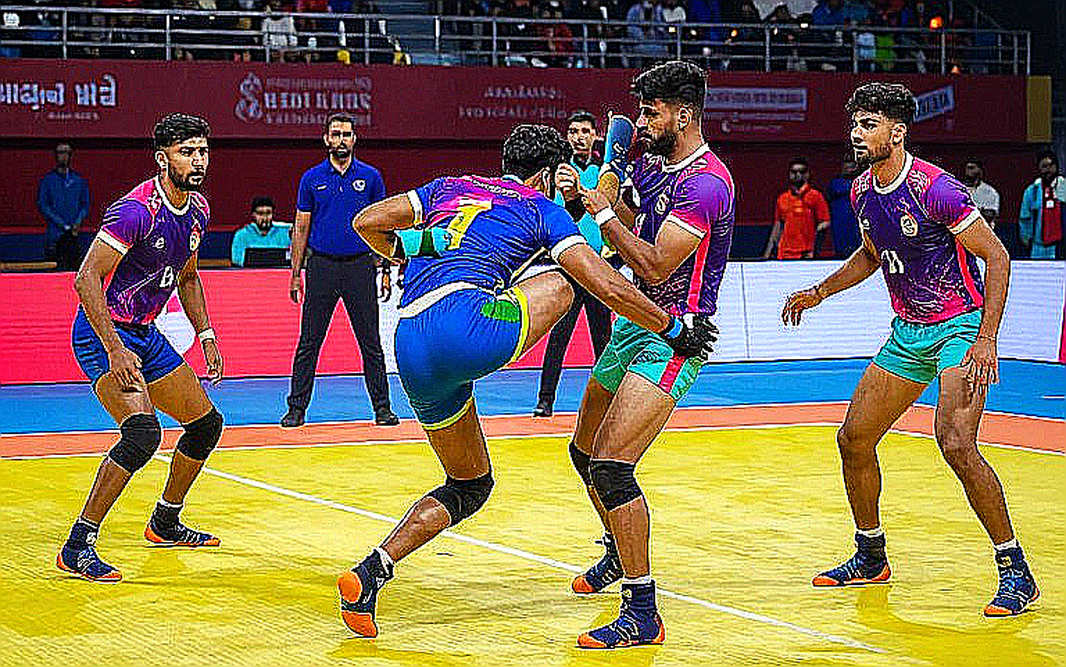
Context: what kind of tournament this actually is
The All India Kabaddi Federation (AKFI) is hosting, and the rules are approved by the International Kabaddi Federation (IKF). That means standard style, not circle style — 13m × 10m rectangle, seven-a-side, a 30-second raid clock, and a cant that cannot break. Five rules will decide the shape of this event: the bonus line's single point, available only when the defending side has six or more players on court; two points plus a full revival on an all out; the super tackle at two points with three or fewer defenders; the super raid at three or more points in one raid; and do-or-die, which forces the third raid after two empty ones and removes the raider himself if it also yields nothing.
That rule layer is not decoration. Every claim attached to this championship — India are strong, the competition is tight, this is 2030 preparation — has to survive the rules and the draw size before it survives anything else. In the Jakarta thread of 2026 I went looking for where a claim was first written down. Same method here.
One honest note: this is a first edition. Comparing it to the PKL or the Asian Games would be a category error. The right comparison is other first editions of multi-sport properties, where the question is field depth, not the anthem.
Core: the arithmetic says what the press release doesn't
Take the 39 men's matches. Two groups of seven and six: 21 and 15 group games, 36 in total, plus two semifinals and a final — 39 exactly. Now the 23 women's matches. Two groups of five and five: 10 and 10, plus two semifinals and a final — 23 exactly. Both figures close perfectly on their own, and that closure is the finding: the men's draw carries 13 teams and the women's draw carries roughly 10, which means at least three nations are not entering a women's team in Ahmedabad. It is arithmetic, not inference. Group compositions have not been disclosed, so my confidence is medium — but the fit is too clean on both sides to call coincidence.
Then there is the number that will not add up. We are told 400-plus players are arriving from 13 countries. Divide it: roughly 31 per nation. That only works if all 13 have entered both genders, which collides directly with a 23-match women's draw. Either one figure is rounded or support staff are being counted as players. A number that cannot reconcile itself cannot underwrite any other claim. I will publish 23, because 23 is checkable, and leave 400-plus where it belongs.
The rules cut in one direction. Standard style under IKF approval is the same family used by the PKL and the Asian Games, so India's adaptation cost is zero — and that zero is the advantage. Standardisation is a convenience for the host and a cost to the contest; it is precisely what makes a Commonwealth field read like a development camp rather than a competition. The bonus line is especially kind to India's raiders against deep, passive defences: a low-risk way to bank single points without attempting difficult touches. Margins swell, tension drains.
The reverse side is do-or-die. It eliminates the weaker team's ability to burn empty raids and stall. Competitively that is fair — nobody escapes for free. Commercially, for a first-edition showcase, it is a problem, because a new property survives on one close match. A wide field plus a rule set that compresses upsets is a recipe for lopsided fixtures.
Then the calendar. Sixty-two matches in nine days is roughly seven a day, which only works with multi-court operations, which means squads returning to the mat without full recovery. For nations without sports-science staff — and this field has plenty — soft-tissue exposure sits at the top. Let me be clear: 62 matches in nine days is not a player weakness, it is a scheduling error. And my standing concern applies: early-maturing young players get pushed into senior rhythms while their bodies are still forming, and in a window like this the youngest squad member's load is the one nobody is counting.
On the squads themselves, the tactical information available is zero. No raid points, no tackle points, no successful raid percentage, no squad lists beyond captains. When the launch event is a jersey-anthem-logo-mascot reveal, the centre of gravity is brand-building, not competition. Any "strong squad" line right now is promotional, not analytical.
And the names deserve honesty. If the vice-captain Naveen Kumar is Dabang Delhi's marquee raider, that signals a genuinely PKL-calibre squad rather than a developmental one — which matters. It is also unverified. Surjeet Singh is a high-frequency name in Indian kabaddi with distinct raiding and defending bearers. Ritu is plainly the short form of a longer registered name. Identity first, praise after. I do not chase the loudest take; I chase the footnote that explains it.
Contrarian: where I could be wrong
The first crack is in my own arithmetic. Group compositions are undisclosed. If the organisers run a single round-robin or a cross-pool format, my entire reconciliation collapses and the women's field could be 12. A clean fit is not a proof.
The second is more serious. I have tied the 2030 claim to draw depth, and that link may be wrong. Multi-sport programme inclusion turns on governance, anti-doping compliance, broadcast footprint and whether a credible women's discipline exists — not on how deep it is. Formally, a 10-team women's draw ticks the box. My charge may reverse: a thin field is not a failure but a reasonable year-one baseline. Several Commonwealth kabaddi nations have no women's programme at all; assembling ten teams there is an achievement, not an omission. I will name the incentive, not a villain.
The third: the rules-favour-India argument depends on the variant being standard style, and the source never names it. If the IKF's current cycle has shifted video review scope or substitution counts, my "zero adaptation cost" claim weakens.
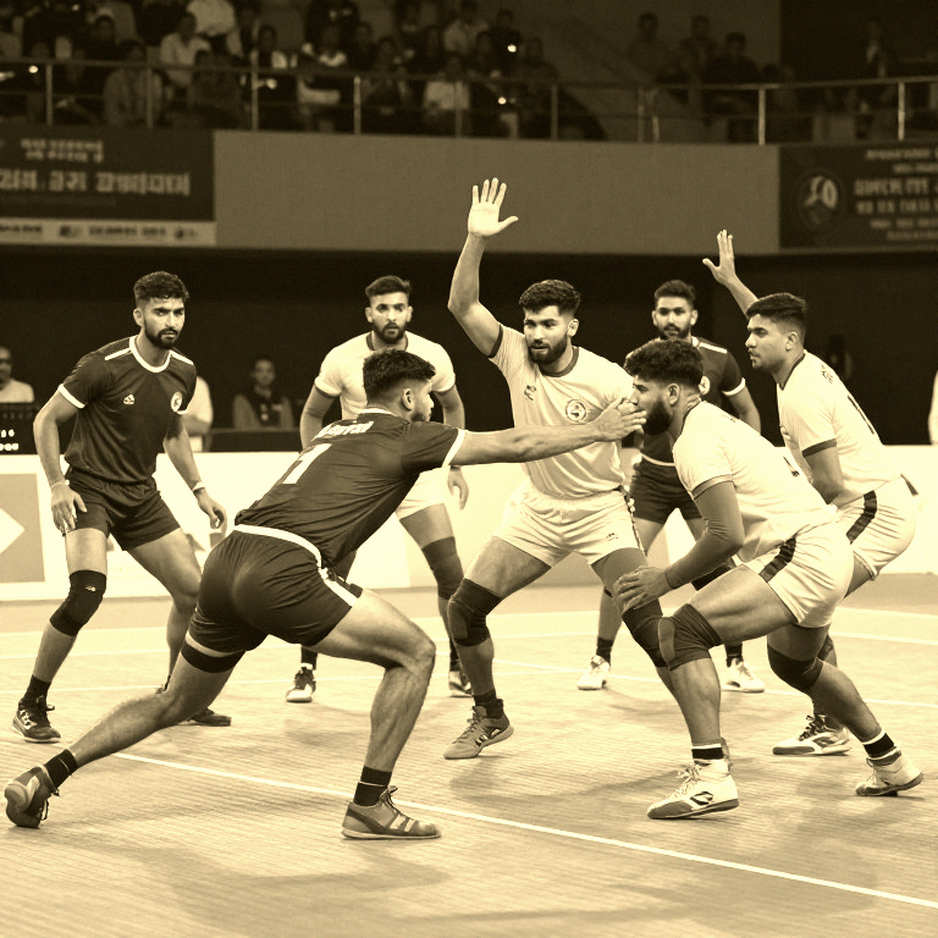
The fourth: I over-flattened the injury argument. Four or five nations with 15-plus squads and rotation will absorb the load; the damage lands on those without options — which is still a system failure, not a player one.
Takeaway: two numbers, two dates
Semifinals on 30 October, finals on 31 October. My testable prediction: India's men will use the group stage for rotation and workload management, and the real selection test is the 30 October semifinal — group scorelines will not measure anyone's strength. In the women's draw I will watch the semifinal margin, and I will count the seats. If India's women win a semifinal by 20 points and the stands are under half full, the 2030 file is being built on paper, not on a product. Empty seats in Ahmedabad are not atmosphere; they are a measurement. And 23 is the number I check before 400-plus.