
Kabaddi: From Mud Courts to Turf and Television, a Homegrown Sport's Global Journey
कबड्डी एक संपर्क-आधारित टीम खेल है जिसमें सात खिलाड़ी प्रति टीम कोर्ट पर होते हैं। पुरुषों का कोर्ट 13x10 मीटर और महिलाओं का 10x8 मीटर होता है; मुकाबला 40 मिनट (दो हाफ) का होता है और हर रेड 30 सेकंड में पूरी करनी होती है। रेडर विपक्षी हिस्से में जाकर डिफेंडर को छूकर अंक कमाता है, पूरी टीम आउट करने पर 'लोना' के दो अंक मिलते हैं। कबड्डी 1990 बीजिंग से एशियाई खेलों का आधिकारिक हिस्सा है, और 2014 में शुरू प्रो कबड्डी लीग ने खेल के व्यावसायिक और प्रसारण-आधारित स्वरूप को स्थापित किया।
In India, kabaddi is often dismissed as a street-corner game. No bat, no ball, no expensive equipment — just a court, seven players a side and the rhythmic chant of 'kabaddi-kabaddi'. Yet over the past decade that very simplicity has turned it into one of sport's most compelling stories. Where cricket and football rest on costly gear and large academies, kabaddi's greatest strength is its reach — from a village school ground to a city indoor stadium, and now straight to the television screen.
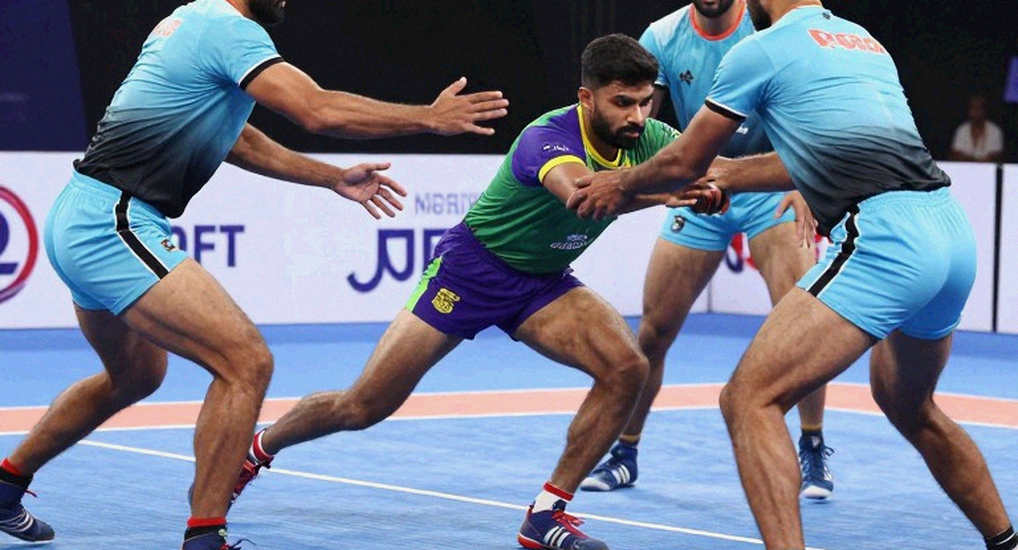
The structure of the game looks simple but is not. The men's court measures 13 by 10 metres and the women's 10 by 8, divided into two halves. Seven players from each side are on the mat, with five substitutes waiting. A match lasts 40 minutes across two halves with a five-minute break, and every raid must be completed within 30 seconds. The raider crosses into the opponent's half, chants 'kabaddi' on a single breath and tries to touch a defender and return to score. If the breath breaks, the raid is dead.
Defence is equally decisive. A single tackle can stop a raider, push him out of bounds, and taking out the entire opposing line — a 'lona' — earns two points. The bonus rule encourages aggression, since a raider can score by crossing the mid-line. That is why tactics shift constantly: when to risk a raid, when to push the defensive line forward and when to sit back and wait.
The single biggest force in reshaping the sport has been the Pro Kabaddi League, launched in 2026. The league moved the game from mud courts to mats and turf, gave matches prime-time television slots, and paid players sums that would have been unthinkable a few years earlier. City franchises, an auction system and player branding — kabaddi borrowed the structure that had worked for cricket, but on its own terms.
Television changed how the sport is understood. When the camera zooms in on a raider's feet, or shows the angle of a defender's shoulder, viewers begin to see how points are made and lost. Slow-motion replays and studio analysis turned kabaddi into a watchable spectacle. For sponsors it delivered an audience distinct from cricket's — rooted in smaller towns and rural areas, drawn to a sport that costs almost nothing to adopt.
Internationally, kabaddi's roots are deepening. It has been an official Asian Games discipline since Beijing 2026, and India dominated the men's event for decades. The picture is no longer one-sided, however. Iran has built a technically formidable programme, while Bangladesh, Pakistan, Sri Lanka, Nepal and Kenya bring their own styles. Investment has also grown in South Korea and Japan. This widening of competition is a healthy sign, because a sport only becomes large when both victory and defeat are genuinely possible.
Kabaddi's real pipeline is the village and the government school. Most top Indian players come from families whose first arena was an empty plot of land. That makes kabaddi one of the cheapest routes to social mobility. The flip side is that talent identification still depends heavily on chance — systematic scouting, age-group competitions and scientific training have not yet spread across the country. States with organised structures supply players continuously; where the structure is thin, talent drops out before it is ever spotted.
Women's kabaddi has gained ground rapidly. Domestic competitions have expanded, state camps have multiplied and players now receive recognition at home and abroad. Challenges remain — sponsorship, media coverage and pay still lag behind the men's game. But the most important shift is that it is now discussed as a career option for young women, not merely a pastime.
The modern game is also undergoing a scientific turn. Speed, reaction time, balance and decision-making during raids are no longer assessed purely on instinct. Teams prepare with video analysis of defensive line height, a raider's favoured foot and tackle tendencies. The consequence is that guesswork is leaving the game, and players must be mentally prepared to the same standard — because a single error in a raid can cost two points.
Another dimension is media and narrative. Televised coverage has given small-town players national recognition. A sport once confined to local fairs and school tournaments now appears in prime time. Yet that coverage is uneven — the intensity of the league season fades in the months between editions. A sustainable ecosystem requires national championships, junior tournaments and state competitions to be covered with the same seriousness, because tomorrow's stars are playing in them today.
The sport faces both technical and administrative challenges. Because it is a contact game, injury management is a major issue — knees, ankles and shoulders take the heaviest load. As fixture density rises, recovery time shrinks. On the other side, consistency in refereeing has repeatedly been questioned. Video referral has improved trust to some degree, but the time taken to reach decisions disrupts the rhythm of play.
A quieter problem is the gap between league and non-league players. Those whose names are known in the league attract sponsorship, while a large number of state-level players still compete with incomplete financial security. The impact lands exactly where it hurts most — the ability to plan a long career.
Some things about the road ahead are clear. If kabaddi wants a market comparable to cricket's, it needs honest data, transparent scouting, strong health protection for players and a stable international calendar. National leagues have begun in several countries in recent years, widening the global base and giving domestic players a route to overseas experience.
Kabaddi's greatest asset is its ease — a sport that can start on a school ground in five minutes and needs no expensive equipment. The real question is whether administrators and organisers can manage that ease alongside the demands of a market. If they can, kabaddi can strengthen, well beyond India, the identity it earned on home soil.
संबंधित खिलाड़ी
लोकप्रिय/पसंदीदा पुस्तकें
From 18-27 to 33-29: What Kabaddi's Thirteen-Point Swing Between India and Iran Actually Measures2026-11-02
Kabaddi's Ledger: Why Women Players Still Sit Outside the Wage Line After Four Asian Golds2026-10-26
The Day-1 Table Is a Mathematical Illusion: The Team That Hasn't Raided Once Is Group B's Real Strength2026-10-25
A Match in Ahmedabad, a Rival Missing: The Biggest Story at the Commonwealth Kabaddi Championship Is an Empty Chair2026-10-23
From 14 to 13: Pakistan Pulled Out, but Iran Was Never on the Sheet2026-10-23
Beyond the Super 10: Kabaddi's Real Scorecard Is Hidden in Efficiency, Payroll and the Raids Nobody Counts2026-10-23
अनुशंसित
First Commonwealth Kabaddi Championship in Ahmedabad: 62 Matches, 13 Nations and the Unfinished Arithmetic of the Women's Draw2026-10-24
Surjeet Singh as captain, Naveen Kumar as deputy: the Commonwealth Kabaddi Championship 2026 announcement that arrived before its own squad list2026-10-23
The Real Ledger of a Kabaddi Auction: Where Raid-Point Counting Misleads2026-10-24
From 14 to 13: Pakistan Pulled Out, but Iran Was Never on the Sheet2026-10-23
Commonwealth Kabaddi in Ahmedabad: The 39-vs-23 Gap Is the Real Headline2026-10-30
Commonwealth Kabaddi: India's 3-0 Is Best Explained Not by Nigeria but by England's 262026-10-27
India vs England, Match 4: In Ahmedabad, the Margin Will Not Measure India2026-10-30
Commonwealth Kabaddi Championship 2026: 13 nations, nine days, and a broadcast nobody has named2026-10-29
अनुशंसित
Kabaddi's Ledger: Why Women Players Still Sit Outside the Wage Line After Four Asian Golds2026-10-26
An Empty Result, a Full Risk Book: The Silent Failure in Kabaddi’s Data Pipeline2026-10-31
Pakistan's Withdrawal and the 13-Team Field: A Format Audit of the 2026 Commonwealth Kabaddi Championship2026-10-29
Surjeet Singh Captain, Naveen Kumar Deputy: At Commonwealth Kabaddi Championship 2026, India's Real Test Is Iran's Absence2026-10-23
Pakistan's Commonwealth Kabaddi Withdrawal: The 14-to-13 Number and a Broken Template2026-10-23
The Kabaddi Auction, the Wage Bill, and the Market the Headlines Never See2026-10-31
From 18-27 to 33-29: What Kabaddi's Thirteen-Point Swing Between India and Iran Actually Measures2026-11-02
From 14 to 13: What Pakistan's Withdrawal Actually Leaves Behind at the Commonwealth Kabaddi Championship 20262026-10-23